Hip Mobility for Desk Workers: What to Do When Sitting All Day Is Killing Your Range of Motion
San Francisco Personal Trainer | FRC Mobility Specialist | TPI Fitness Coach
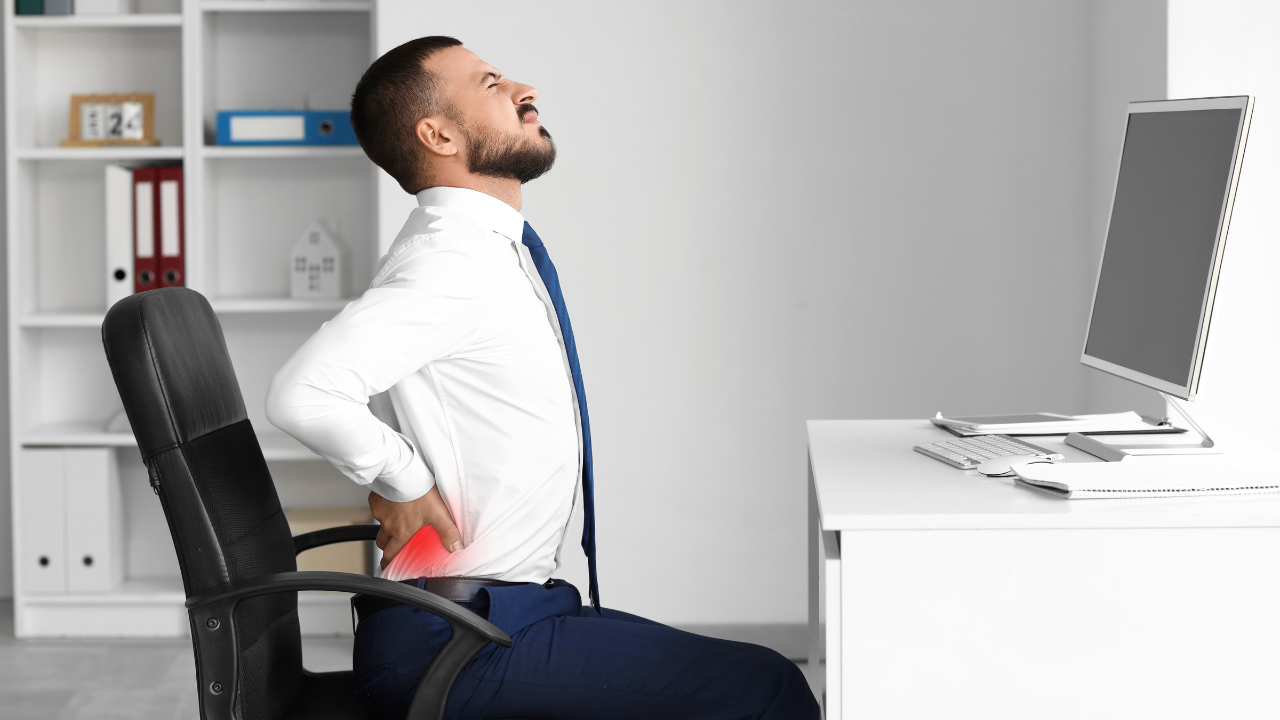
If you sit for most of your working day and your hips feel perpetually “tight”, you have probably already tried stretching. You have held the hip flexor stretch. Maybe you have done pigeon pose. You roll out your quads on a foam roller. It helps for a little while and then the tightness comes back, and after enough cycles of that you start to wonder whether this is just something you have to live with.
It is not. But the reason the stretching keeps failing is not because you are not doing enough of it. It is because stretching is addressing the wrong problem.
Prolonged sitting does not shorten your hip flexors. It trains your nervous system to treat certain ranges of motion as unavailable. The body is adaptive in ways that can work against you sometimes. Spend enough hours in a compressed hip position and your brain stops considering hip extension a safe and accessible option. No amount of passive lengthening changes that. What changes it is teaching the nervous system that those ranges are both accessible and under your control.
You become what you do most frequently in life.
This article explains what is actually happening in your hips when you sit all day, why the standard approach fails, and what the research-supported alternative looks like in practice. I also have a video below that shows the specific drill I use with clients, from desk workers, executives, and golfers, who come in with restricted hip extension and leave with ranges they did not think they still had.
If you want to understand more about the difference between mobility training and stretching in general, this article on why mobility training matters more than stretching covers the broader principle.
“Spend enough hours in a compressed hip position and your brain stops considering hip extension a safe and accessible option.”
What Is Actually Happening When Your Hips Feel Tight
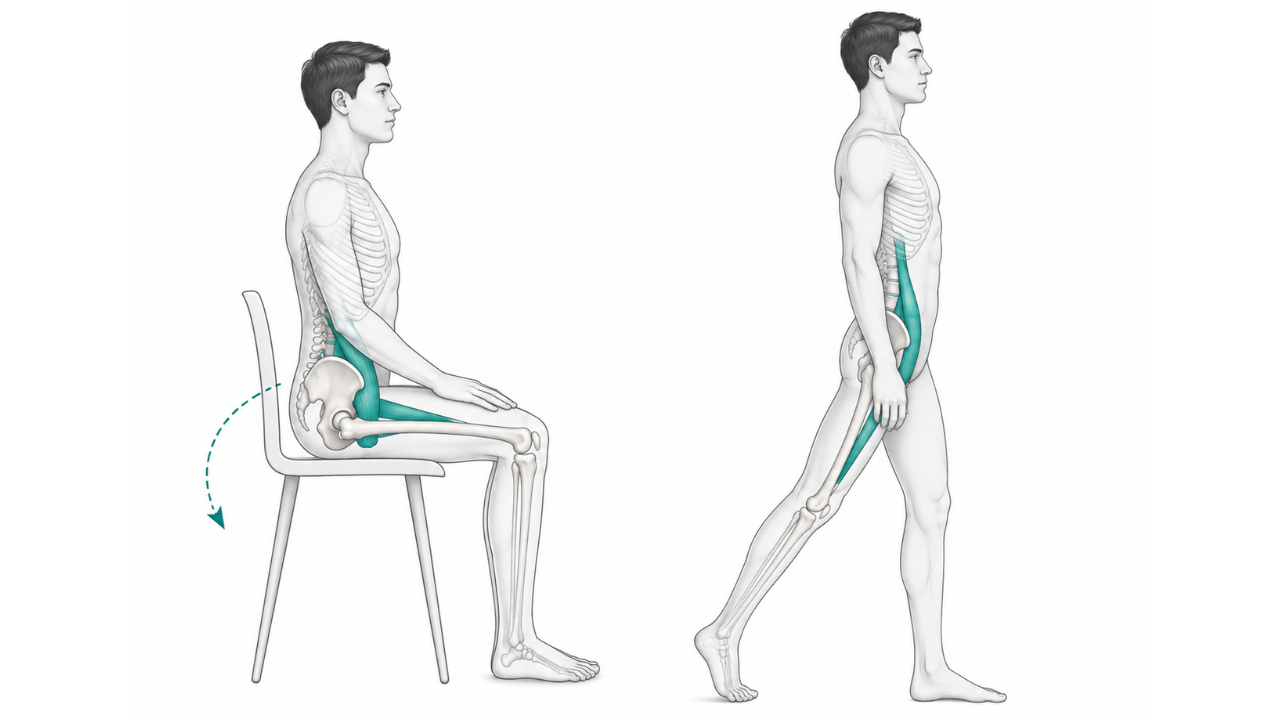
The sensation of hip tightness from sitting is real, but the mechanism behind it is frequently misunderstood. Most people assume the hip flexors are short and need to be stretched. Sometimes that is true. But more often what is happening is a combination of two things: neural inhibition of hip extension, and a lack of active control in the ranges the hip can technically access.
Neural inhibition means your nervous system has downregulated the signal to the muscles responsible for extending the hip. When you spend eight to ten hours a day with the hip in flexion, the body interprets that as the working range. Hip extension: the ability to drive the thigh behind the body, gets progressively deprioritized. Over time it is not that the tissue cannot get there. It is that the nervous system has stopped volunteering to go there.
The second issue is active control. Even in people who have maintained some degree of hip extension range, that range is often passive only. They can be moved into it. They cannot actively move into it themselves, and they certainly cannot produce force there. That distinction matters enormously for training, for athletic performance, and for the long-term health of the hip joint.
Both of these problems have the same solution. You need to teach the nervous system that hip extension is accessible, and you need to train the muscles to produce force at end range. Holding a stretch does neither of those things. Active range development does both.
Why Stretching Alone Does Not Fix Tight Hip Flexors
Passive stretching creates length in tissue temporarily. You pull the hip flexor to end range, hold it, and release. The tissue may feel less restricted for a period afterward. But passive stretching does not produce the neural changes required to make that range available under load, and it does not build the strength at end range that makes the improvement stick.
This is why the stretch feels good and then the tightness returns. You have not changed what the nervous system considers accessible. You have only temporarily exceeded it and then returned to baseline.
The approach that actually works is one that communicates with the nervous system directly. You take the hip into the range that feels restricted, and then you produce an isometric contraction at that position. You are not just being there passively. You are actively telling the nervous system that this range is safe, controllable, and worth keeping. That signal, repeated consistently, is what produces lasting change in hip extension range.
The specific method I use with clients is called PAILs and RAILs. Progressive and Regressive Angular Isometric Loading. It comes out of the Functional Range Conditioning system and it is one of the most effective approaches that I have found for restoring hip range in people whose hips have been compressed by years of desk work.
“Passive stretching does not change what the nervous system considers accessible. Active range development does.”
What This Looks Like in a Training Program
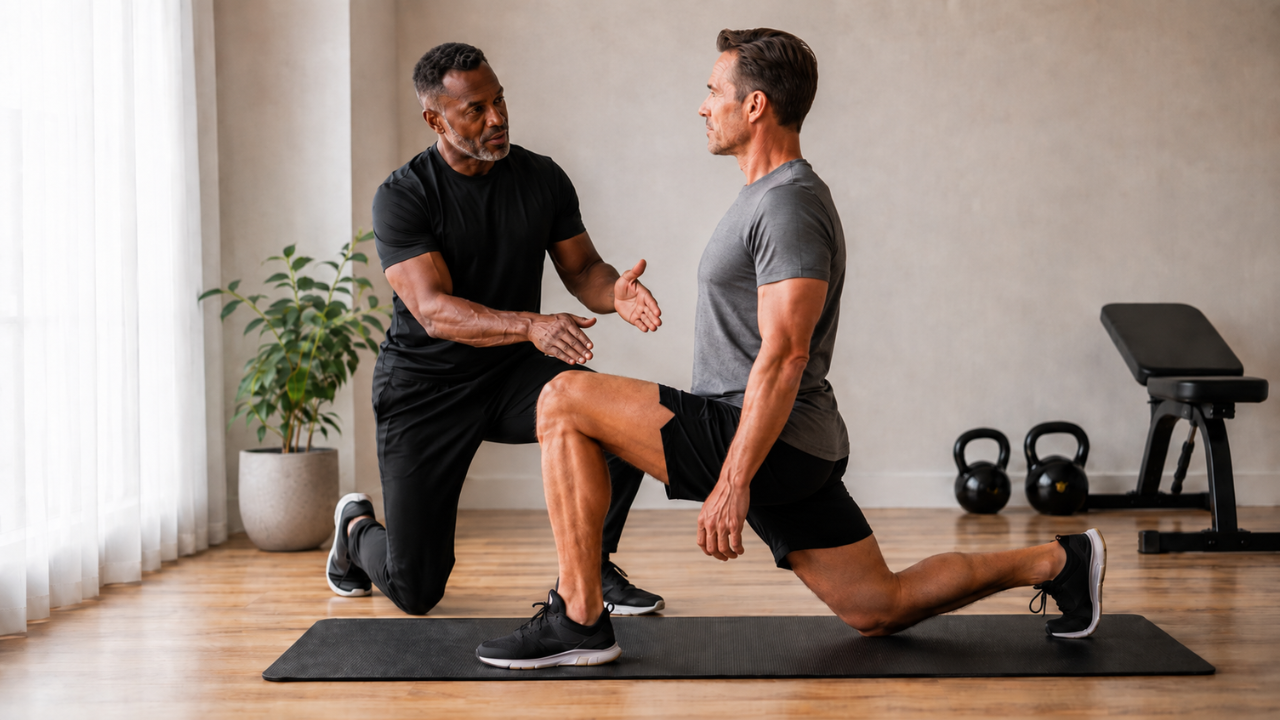
The drill in the video is not a warmup. It is training. Done correctly, a single set of PAILs and RAILs in split kneeling for hip extension is genuinely fatiguing in a way that passive stretching never is. That fatigue is the signal that real adaptation is occurring.
In terms of programming, I typically introduce this work in the early part of overall training and in the early part of a training session before strength training begins, while the nervous system is fresh and capable of producing the contractions at the quality required.
Consistency is the operative word. One session does not change a pattern built over years of sitting. But three sessions per week for four to six weeks produces measurable and lasting improvements in active hip range. What those improvements unlock downstream in strength training, in golf performance, in the way the lower back feels at the end of the day is significant.
The assessment-first approach I use with every client includes hip range of motion as a key marker precisely because so many people are limited here without knowing it, and because the downstream effects of that limitation show up throughout the rest of their training.
The Downstream Effects of Restricted Hip Extension
Most people with restricted hip extension think of it as a hip problem. In practice it creates problems well beyond the hip itself.
Lower Back Pain
When the hip cannot extend fully, the lumbar spine compensates by extending instead. This is one of the most common contributors to low back pain in desk workers and in people who lift. The back is not the primary problem. It is often absorbing demand that should be going through the hip, but aren’t because the hip is not available to take it.
Knee Strain
Restricted hips alters the mechanics of the entire lower extremity kinetic chain. The knee ends up doing work it was not designed for. Over time this often contributes to many issues, from Patellofemoral, IT band problems, and general knee discomfort that seems to come from nowhere.
Golf Performance
Hip extension at the rear leg is a fundamental component of a powerful and repeatable golf swing. Restricted hip extension limits rotation, forces compensation through the spine, and caps club head speed regardless of how strong the upper body is. A large proportion of the golfers I work with through TPI have hip extension deficits that are directly limiting their swing and that improve significantly once the hip mobility work is addressed.
Strength Training Plateau
In squats and deadlifts, hip extension restriction shows up as butt wink, early forward lean, or an inability to maintain optimal spine position under load. These are not technique problems in isolation. They are often mobility problems presenting as technique problems. Coaching the pattern without addressing the underlying restriction produces limited results. Addressing the restriction first tends to resolve the technique issue without further intervention.
“Lower back pain, knee strain, golf compensation, and strength plateaus all have hip extension restriction as a frequent contributor.”
What to Do Starting Today
If you sit for most of your working day and your hips feel restricted, the drill in the video above is a practical starting point. Here is how to approach it.
Start With One Side at a Time
Get into a split kneeling position with the rear knee on the floor and the front foot forward. Square your hips. Posteriorly tilt your pelvis slightly, think about tucking your tailbone under rather than letting your low back arch. This is the position that actually loads the hip flexor at the rear leg rather than allowing the lumbar spine to compensate.
Build the Contraction Progressively
Hold the position and gradually ramp up a contraction of the rear hip flexor as if you are trying to drag the rear knee forward along the floor without actually moving it. Build to about 60 percent of maximum effort over 10 seconds, then hold for the remainder of a one minute total hold time. This is the PAILs component.
Follow With the RAILs
After the PAILs contraction, actively drive the rear hip into greater extension by contracting the glute of the rear leg. You are not pushing further with external force. You are actively moving the hip further into the restricted range using your own muscles. Hold that position for 10 seconds. This is the RAILs component, and it is what teaches the nervous system that the new range is usable.
Frequency Matters More Than Duration
Two minutes per side, three times per week, done consistently over four to six weeks will produce more lasting change than an hour-long stretching session once a week. The nervous system responds well to repetition.
If you want to understand how this kind of targeted mobility work fits into a broader training program built around your specific restrictions, the article on strength training after 40 covers how mobility and strength development work together for long-term results.
Want coaching through this work in person?
Hip mobility is one of the most common restrictions I find in the assessments I run with new clients in San Francisco, Burlingame, Hillsborough, Atherton, and Palo Alto. If you are a desk worker in your 40s or 50s and your hips are limiting your training or your daily comfort, I can show you exactly where the restriction is and build a program that addresses it directly.
Learn more about working together in-home and in-studio training
About Coach Rich Thurman
Coach Rich Thurman is a personal trainer and mobility specialist with over 20 years of experience. He provides concierge in-home personal training in Burlingame, Hillsborough, and Atherton, and in-studio training at Back 2 Sports and Kauno SF in San Francisco. Rich specializes in mobility, functional range conditioning (FRC), strength training for longevity, and sport-specific performance for golfers and other athletes. His approach is assessment-first, education-based, and built around the individual needs of each client.
Related Articles
Why Mobility Training Matters More Than Stretching for Busy Professionals
The Assessment-First Approach: Why Knowing Your Starting Point Changes Everything
3 Things to Assess Before Increasing Training Intensity
Strength Training After 40: Why It Is the Most Important Thing You Can Do for Longevity
View all articles at coachrichthurman.com/insights