Why Your Steel Mace Swing Might Be Hurting Your Neck and Shoulders: A Case Study in Movement Assessment
San Francisco Personal Trainer | FRC Mobility Specialist | Steel Mace Educator

Someone reached out after finding my Steel Mace content on YouTube. They had been training with the mace on their own for several months, working through the 360 swing and the 10-to-2, and had reached a point where something clearly was not right. Their neck was chronically irritated after sessions. Their right shoulder felt uncomfortable at the top of the swing. They had watched more videos, adjusted their positions, tried different stances, but nothing resolved it.
This person came to me thinking they needed better technique cues. However, I approach every client in the same manner. We begin with internal assessment before pursuit of external goals. In our 30 minute consult call, we agreed that this is the appropriate place to begin in order to establish a Point A.
This client was in their mid 30’s, trains with the Steel Mace and had been doing Olympic Lifting for a bit. They came in with a movement history that included a reported incident at the right shoulder during bench pressing. Over the course of one movement assessment session where we focused on problem areas, the picture became much more clear. The technique problems were real, but they were on the external side of training. The causes were sitting in the data, embedded deep within this person’s movement capacity.
What the Assessment Showed
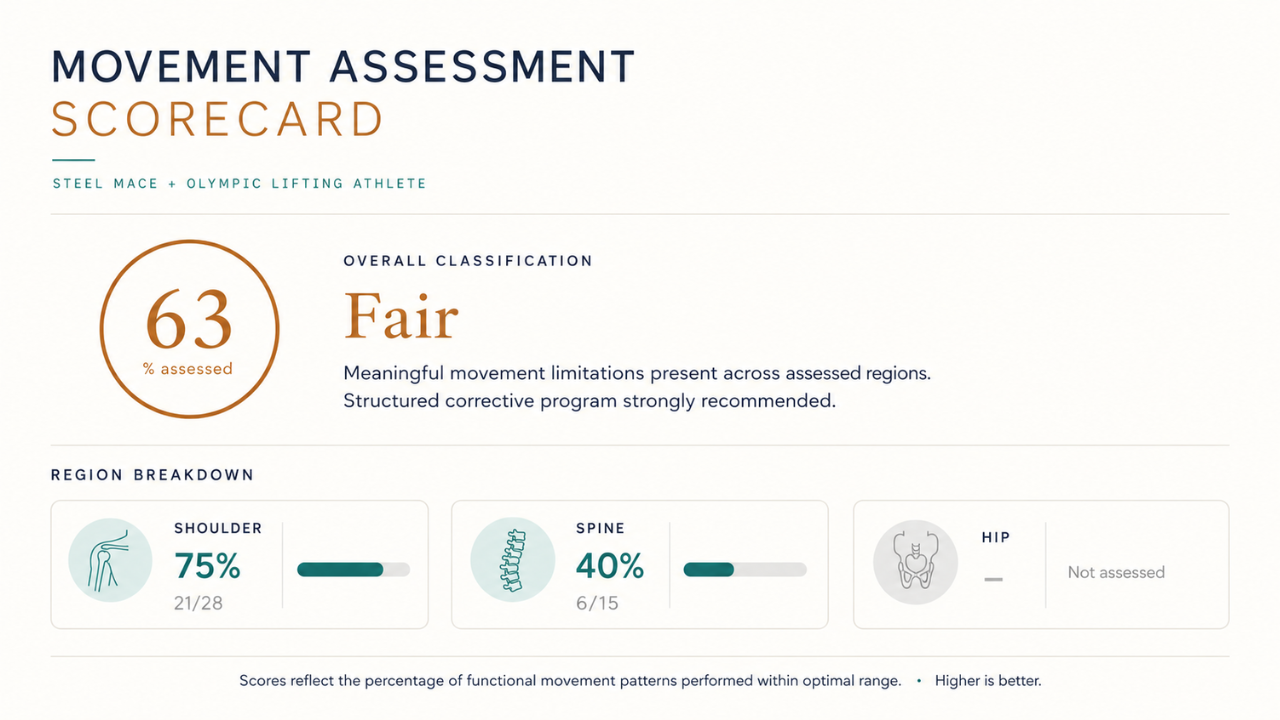
The movement assessment scored them at 63 percent overall, classified as Fair. That number matters because it reflects how much of the body's available movement capacity is actually functioning at a level that can support the demands being placed on it. At 63 percent, meaningful limitations are present across multiple regions, and a structured corrective program is strongly indicated before adding load or skill complexity.
Here are the specific findings that directly relate to the Steel Mace swing and the neck and shoulder symptoms.
Right Shoulder External Rotation: 0/4 — Urgent, Pain Protocol
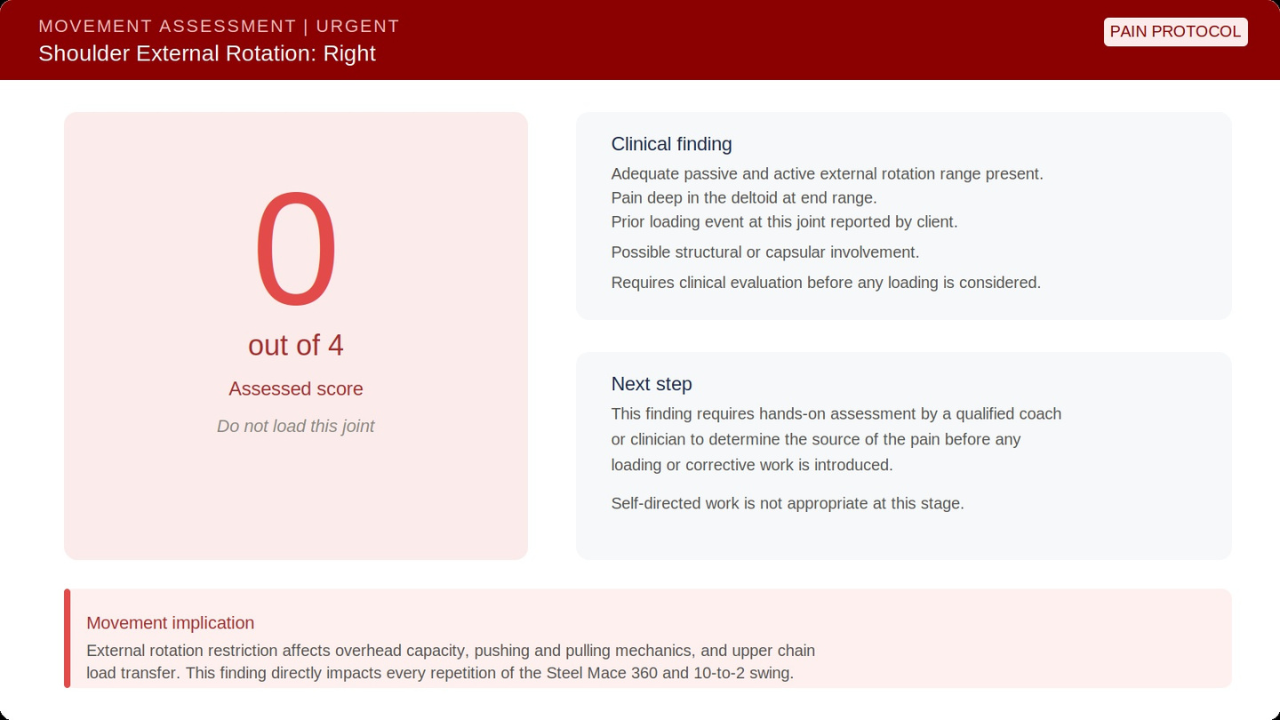
Pain deep in the deltoid at end range. Reported bench press incident. Do not load. Assess CAJP (closing angle joint pain) vs end-range tissue pain. Gentle range within pain-free zone only.
This was the most significant finding in the assessment. The right shoulder had adequate passive and active external rotation range, but at end range there was pain symptom deep in the deltoid consistent with either a structural or capsular issue. The client had reported that something happened during a bench press session, suggesting a prior loading event may have created a joint position sensitivity that had not been addressed.
In the context of the Steel Mace swing, this finding is critical. The 360 and 10-to-2 place the shoulder in an end-range overhead position on every repetition. If the right shoulder external rotation is painful or sensitive at end range under assessment conditions with no load, loading it with a mace through hundreds of reps over multiple sessions is not technique refinement. It is cumulative joint stress on a compromised structure.
Left Shoulder External Rotation: 3/4 — Low Priority, PAILs and RAILs Indicated
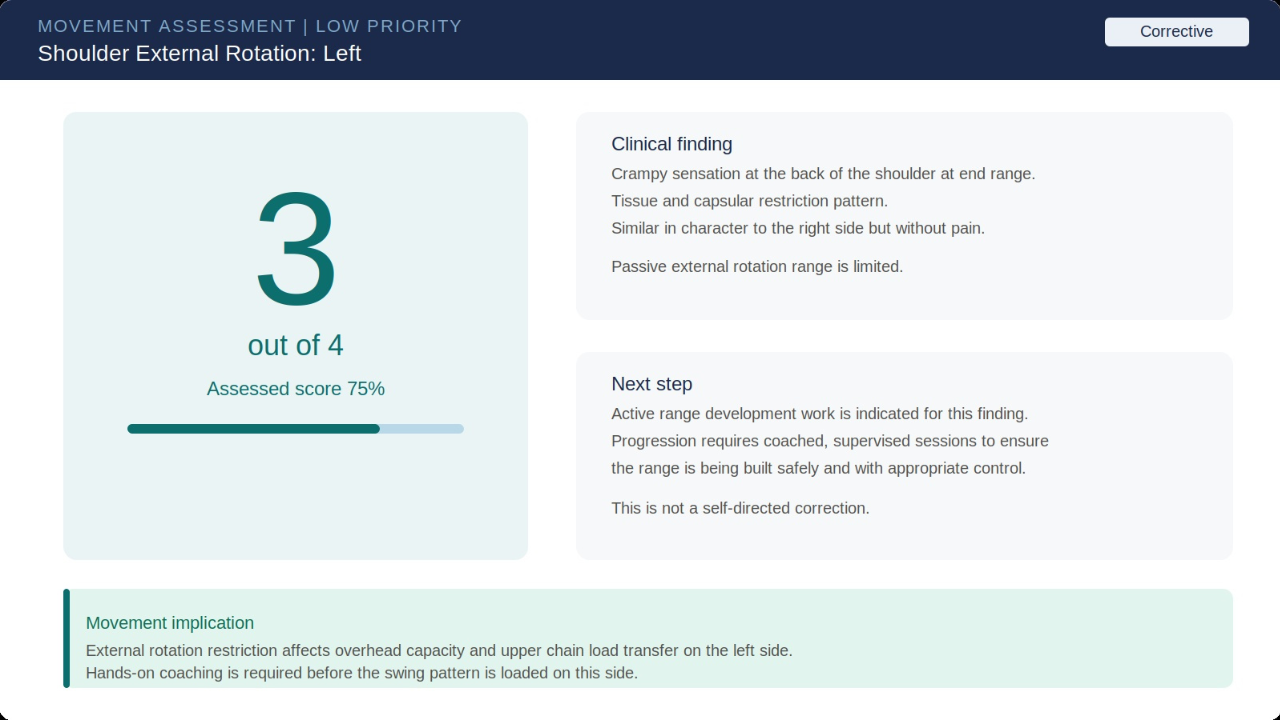
The left shoulder presented with a crampy sensation at end range of external rotation, similar in character to the right side but without the pain quality. This is a tissue and capsular restriction pattern that responds well to the PAILs and RAILs protocol. The cramping is expected and should be coached through rather than avoided. The left side was flagged as lower priority than the right but still requires direct attention before increasing swing load.
GH CARs Both Sides: 2/3 — Compensatory Patterns Throughout
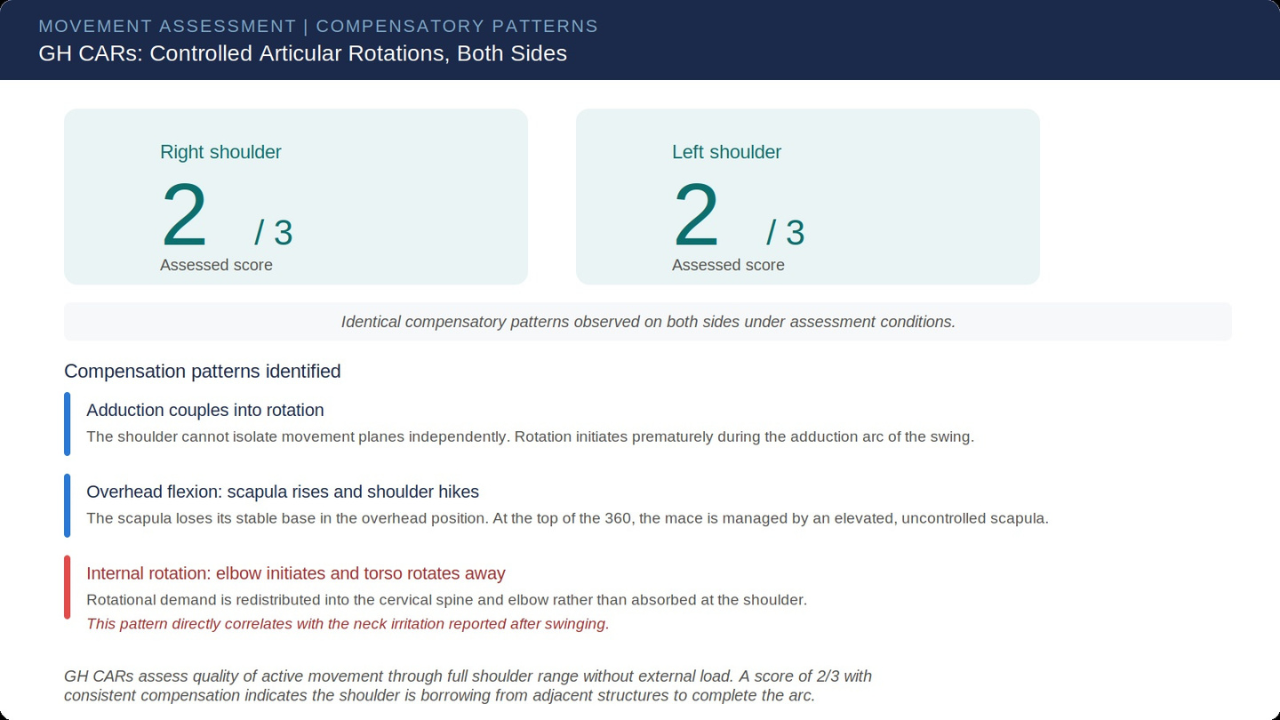
These findings are where the swing mechanics conversation became very specific. Controlled Articular Rotations of the Glenohumeral joint assess the quality of active movement through the full shoulder range without load. A score of 2/3 on both sides with consistent compensation patterns tells us that the shoulder is not moving with independence. It is borrowing from adjacent structures to complete the arc.
In the thought process, we know that joints and tissues work interdependently, but independence of movement is the limiting factor in what can be done INTERDEPENDENTLY.
The three compensations noted are highly relevant to the Steel Mace swing. When adduction couples into rotation, the shoulder cannot isolate its movement planes independently. When overhead flexion causes the scapula to rise and the shoulder to hike, the ball of the mace at the top of the 360 is being managed by an elevated and uncontrolled scapula rather than a stable one. And when internal rotation initiates at the elbow and the torso rotates away, the body is redistributing the rotational demand of the swing into the cervical spine and the elbow rather than absorbing it at the shoulder. That is exactly where his symptoms were presenting.
Lumbar and Thoracic Spine: 1/3 — Across All Spinal Patterns
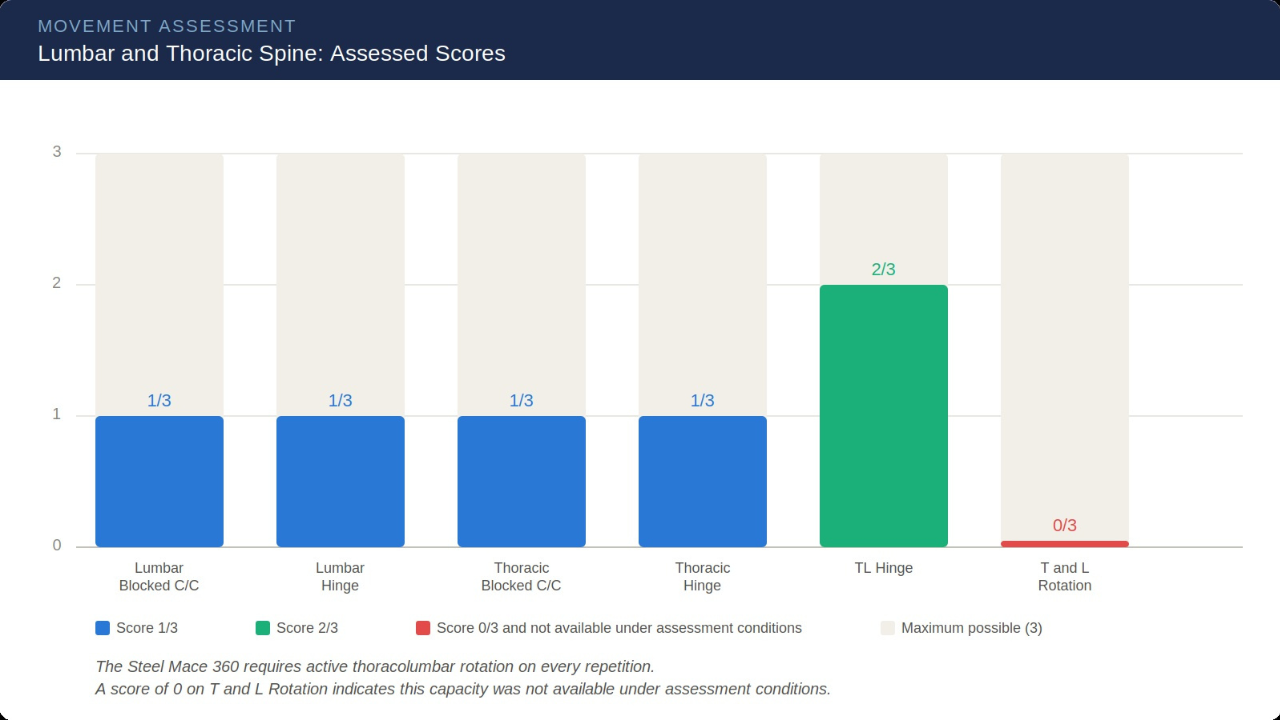
Rotational capacity of the thoracolumbar spine not available under assessment conditions. Flexion and Extension are the fundamental movements of the spine. Flexion is required for adequate rotation.
This finding that was important to potential drive of neck irritation. Both the lumbar and thoracic spines scored 1 out of 3 across all blocked segmental patterns.
The Steel Mace 360 is a movement that requires a lot from the spine. The torso needs to participate actively in managing the arc of the mace as it passes behind the body and overhead. When the thoracic spine cannot flex and extend well, then it cannot rotate well either, and the lumbar spine cannot absorb load in rotation. If you couple this with shoulder range issues, the cervical spine becomes the only mobile structure available to allow the mace to clear the body at the top of the swing. It extends, rotates, and braces to compensate for the spinal segments below it that have checked out. After enough sessions of that pattern, the neck lets you know.
What the Spine Has to Do With It
I taught Steel Mace workshops for years and the point I made with every group I worked with is that the swing is a whole body movement that most people attempt to execute from the shoulders alone. The spine is not a passenger. It is an active participant in distributing and redirecting the rotational force that the mace generates as it travels its arc.
A spine that can move freely through rotation and extension allows that force to be shared across multiple segments. A spine that is restricted at 1 out of 3 across its lumbar and thoracic segments concentrates that force into fewer and fewer locations. In this client's case, the force concentrated into the cervical spine because it was the most mobile region available. That is not a technique problem. It is a structural availability problem presenting as a technique problem.
The video below covers some specific spinal mobility work I use to prepare the thoracic spine for Steel Mace training. If your neck or lower back is irritated after swinging, and you have never had your spinal segmental mobility assessed, this is where the conversation should start.
Spinal mobility work that prepares the thoracic spine to distribute rotational load properly during the Steel Mace 360 and 10-to-2 swing.
The Olympic Lifting Carryover Problem
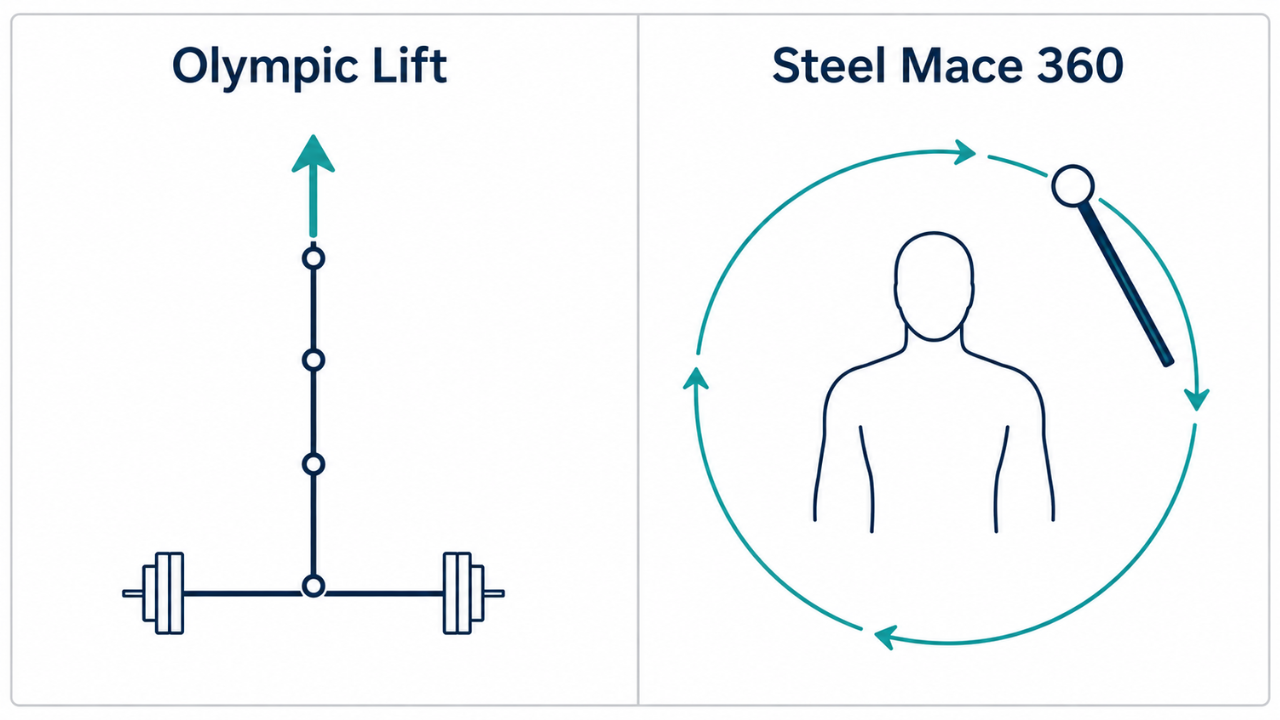
Power that works in a straight vertical line does not automatically transfer to a rotational arc.
The second layer of the assessment was about movement strategy rather than mobility. This client had trained Olympic lifting seriously, and the snatch and clean had built in a movement approach that was well suited to those demands but counterproductive in the Steel Mace swing.
Olympic lifting is built on explosive vertical force, transmitted through a rigid and braced midline, expressed as speed through the bar. You generate maximal power, you brace to protect the spine during the catch, and you move the bar through a linear path as efficiently as possible. That pattern, repeated over years of serious training, becomes the default strategy for any loaded movement that involves a bar in the hands.
The Steel Mace swing asks for almost the opposite. The arc of the mace is circular and continuous. The force is rotational and sequential rather than vertical and explosive. The spine should be mobile and participating, not braced and rigid. The mace needs to be guided through its arc rather than driven. The moment you apply the Olympic lifting strategy to the mace, the mace fights back. The arc becomes choppy at the handoff point. The shoulders absorb impact at the top rather than redirecting momentum. The grip stays too tight throughout. The lats fire at the wrong moment in the arc.
When we got to the point about a month in where things had improved we looked at the swing technique. The client’s 360 showed a distinct pause and re-initiation at the top, a signature of an explosive initiation strategy trying to restart the mace rather than allowing the arc to carry through naturally. Their thorax was locked when it should have been mobile. They snapped their hips like an explosive snatch. Their neck was extending at the exact moment the mace cleared the head, compensating for the lack of thoracic participation below.
“The mace does not want to be muscled. It wants to be guided. Applying an explosive rigid strategy means the mace fights back.”
The Program We Built
Given the assessment findings, the program had two parallel tracks that needed to run simultaneously rather than sequentially.
Track 1: Right Shoulder: Pain Protocol First
The right shoulder external rotation finding was flagged urgent and placed on a pain protocol. Before any loading, the priority was identifying whether the pain at end range was joint position pain, which would suggest a structural or capsular issue requiring medical evaluation, or end-range tissue pain, which is a different problem with a different intervention. No Steel Mace swinging on the right side until this was clarified and the shoulder could be assessed within a pain-free zone.
Track 2: Left Shoulder and Spinal Mobility
For the left shoulder, we implemented the PAILs and RAILs protocol for external rotation using a supine loaded stretch held for over two minutes per set, with contractions into and out of the restriction. The cramping the client experienced at end range was expected and coached through rather than avoided. This is the same active range development principle covered in the hip mobility article applied to the shoulder.
For the spine, we began with the segmental mobility work shown in the video above, targeting the thoracic segments specifically. The goal was not just to add passive range but to teach the nervous system to participate in rotational tasks through the mid-back. This is the prerequisite work for the swing to become what it is designed to be. We also addressed GH CARs quality directly, working on isolating the shoulder from the scapula and the scapula from the thorax so the compensation patterns in the assessment would begin to unwind.
Track 3: Swing Re-Patterning
We broke the swing down to its foundational components and rebuilt it without the explosive initiation strategy. Pendulum work came first, which forces the practitioner to follow the mace rather than drive it. Then slow, deliberate 360 passes with a light mace, with full attention on the handoff at the top and the transition through the back of the arc. Breathing patterns were addressed to keep the thorax mobile rather than braced. The objective was a different internal experience of the movement, not just a corrected external shape.
What This Means If You Train With a Steel Mace on Your Own
This client's situation is not unusual. It is representative of what I see regularly with self-taught Steel Mace practitioners. The tool looks learnable from video. The gross pattern of the 360 and 10-to-2 is visible and seems replicable. But the mace is a tool that amplifies restriction into injury faster than most implements because of the lever arm physics involved. The effective load at the shoulder increases significantly as the ball of the mace moves further from the body, which means a restriction that is manageable with a dumbbell becomes consequential with a mace.
If you have been experiencing neck irritation, shoulder discomfort, elbow issues, or lower back tension after Steel Mace training, the first question is not which cue you are getting wrong. The first question is what your thoracic spine and glenohumeral joint can actually do before you pick up the mace. The assessment-first principle applies here as directly as it does in conventional strength training. Understanding what your body can access and control before adding load is the prerequisite for training with this tool rather than being trained by it.
A Note on Steel Mace Coaching
I have been working with the Steel Mace since before it had the community and commercial presence it has today. I have run workshops in San Francisco, across the country, and internationally from Ireland to Singapore. What I have learned across that time is consistent: the mace rewards patient skill development and punishes the approach of adding load or complexity to a pattern that is not ready for it.
This client came to me through YouTube and has a new training approach, and a clearer picture of their body, that no amount of video watching could have provided. They also have a greater understanding of their mobility as it relates to all of their training, and are now continuing as a client seeking a more complete guidance in more traditional strength training modalities as well as bodybuilding.
The hands-on assessment revealed things that are simply not visible on a screen. The cervical compensation pattern, the scapular hiking under GH CARs, the spinal segments that had opted out of rotational participation. None of those findings come through in video review alone. They require a trained eye in the room and a structured process for gathering the data.
If you are serious about Steel Mace training or Exercise programming in general and want coaching that addresses both the skill and the movement quality that makes the skill safe and sustainable over time, that is the work I do.
Interested in Steel Mace coaching or a full body movement and mobility assessment?
I work with clients in San Francisco, Burlingame, Hillsborough, Atherton, and Palo Alto through concierge in-home sessions. I also work in private in-studio training at Kauno SF. Every new client begins with a full body movement assessment. Steel Mace coaching is available as a standalone skill focus or integrated into a broader training program.
About Coach Rich Thurman
Coach Rich Thurman is a personal trainer, mobility specialist, and Steel Mace educator with over 20 years of experience. He holds certifications in Functional Range Conditioning (FRC) and TPI Fitness, and has led Steel Mace workshops in San Francisco and internationally. He provides concierge in-home personal training in Burlingame, Hillsborough, and Atherton, and in-studio training at Kauno SF in San Francisco.
Related Articles
The Assessment-First Approach: Why Knowing Your Starting Point Changes Everything
Why Mobility Training Matters More Than Stretching for Busy Professionals
Hip Mobility for Desk Workers: What to Do When Sitting All Day Is Killing Your Range of Motion
3 Things to Assess Before Increasing Training Intensity
View all articles at coachrichthurman.com/insights