Strength Training After 40: Why It Is the Most Important Thing You Can Do for Longevity
San Francisco Personal Trainer | FRC Mobility Specialist | TPI Fitness Coach
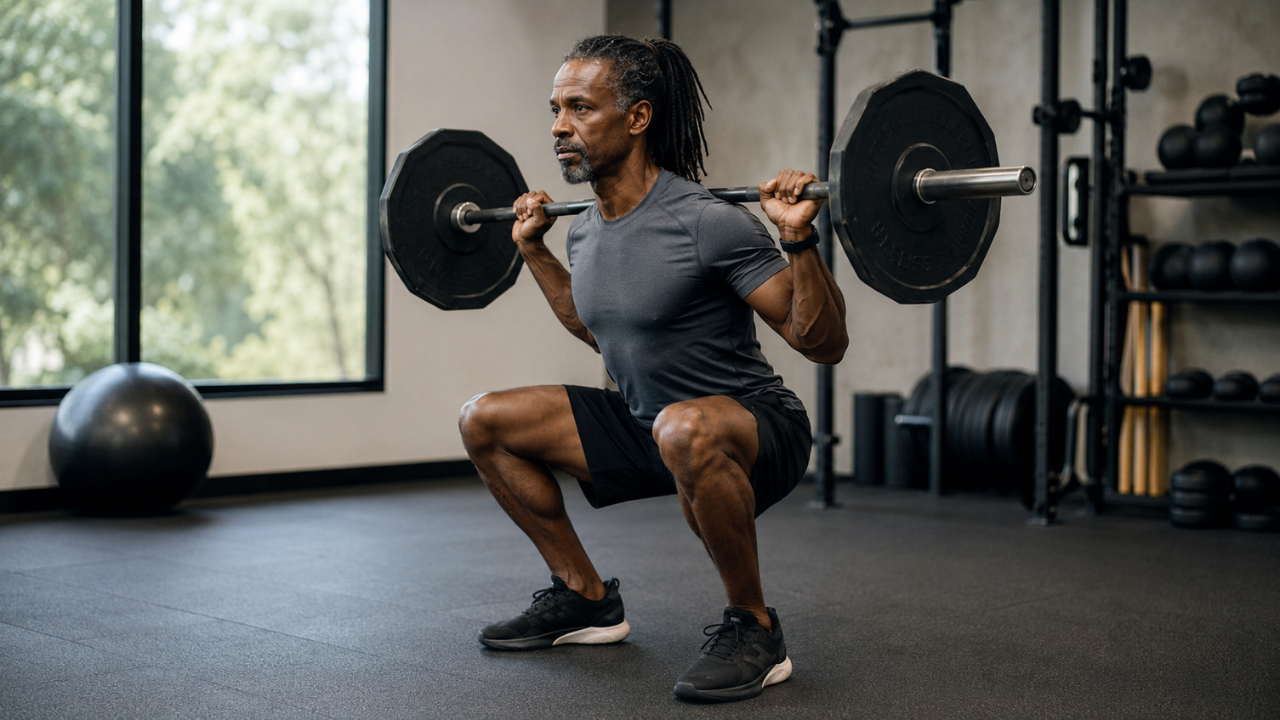
Something happens to most people in their 40s. The body that once absorbed hard training and bounced back quickly starts to send different signals. Recovery takes longer. A joint that was never a problem now has an opinion about certain exercises. Energy feels a little less automatic. And somewhere in the background, a quiet question forms: is this just aging, or is there something I can actually do about it?
The answer is yes. And the most powerful tool available to you is not a supplement, a recovery device, or a new diet protocol. It is resistance training. Consistent, progressive, well-designed strength work is the single most evidence-backed intervention for long-term health, function, and quality of life after 40. This is not a fitness opinion. It is what the science has been telling us clearly for two decades.
“Resistance training is the single most evidence-backed intervention for long-term health and quality of life after 40.”
This article explains why that is true, what actually happens to the body without it, and what intelligent strength training looks like for busy professionals in their 40s, 50s, and beyond.
What Happens to the Body After 40 (Without Resistance Training)
Starting in your mid-30s and accelerating through your 40s and 50s, the body undergoes a process called sarcopenia the gradual loss of muscle mass, strength, and function. Without deliberate intervention, adults lose roughly three to five percent of their muscle mass per decade after 30, with that rate increasing after 60.
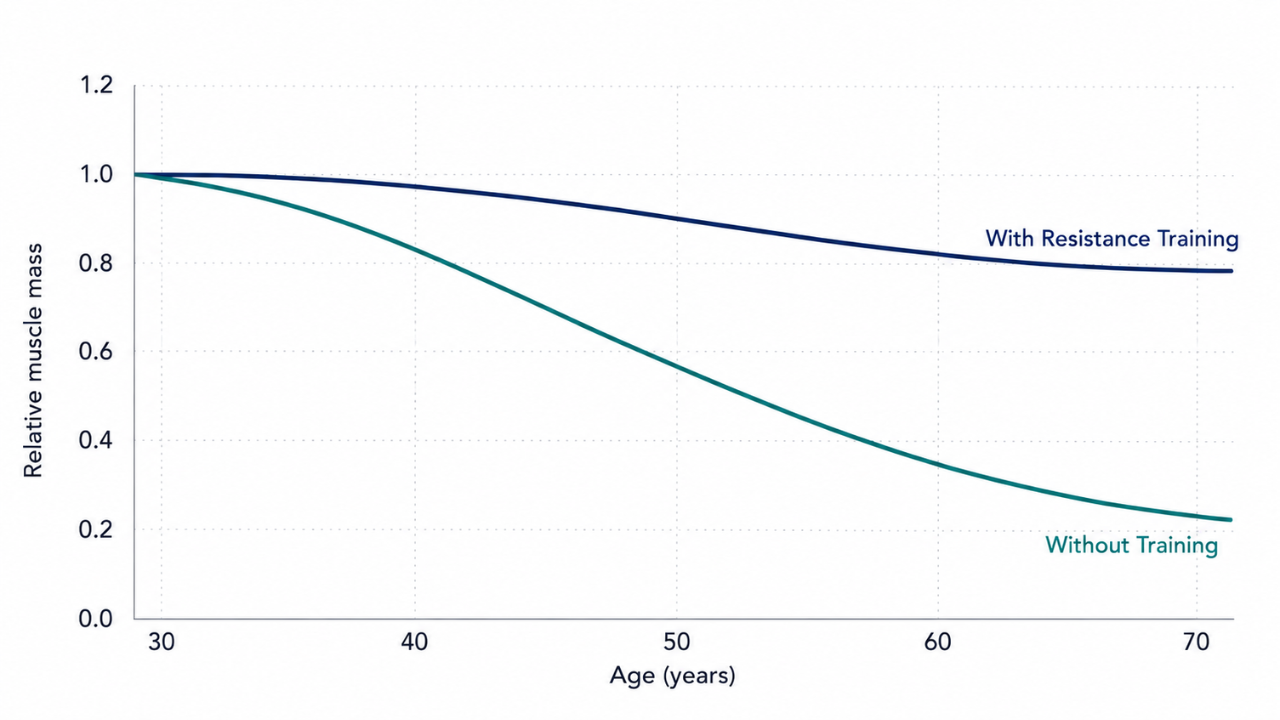
Muscle is not just tissue that moves weight. It is metabolically active. It regulates glucose, supports hormone production, protects joints, and governs how the body responds to everything from illness to injury. Losing it has consequences that go well beyond feeling weaker or looking different.
Specifically, declining muscle mass is associated with increased risk of type 2 diabetes, greater susceptibility to falls and fractures, reduced bone mineral density, slower metabolic rate, and accelerated cognitive decline. These are not hypothetical risks. They are well-documented outcomes in people who remain sedentary as they age.
The good news is that sarcopenia is largely preventable. And for those who have already experienced some muscle loss, much of it is reversible. The mechanism is resistance training. The body responds to the stimulus of load at any age. Research consistently shows meaningful strength and hypertrophy gains in adults in their 60s, 70s, and even 80s when they engage in structured resistance programs.
“Muscle is not just tissue that moves weight. It governs how your body responds to everything from illness to injury.”
Why Strength Training Is Particularly Critical After 40
There are several reasons why the 40s represent a turning point, and why strength training becomes non-negotiable at this stage rather than optional.
Hormonal Shifts Accelerate Muscle Loss
Testosterone and growth hormone, both of which support muscle maintenance and recovery, begin declining meaningfully in the 40s for both men and women. Estrogen changes in women through perimenopause and menopause affect bone density and body composition significantly. Resistance training directly stimulates the hormonal and muscular adaptations that counteract these shifts.
Bone Density Responds to Load
Osteopenia and osteoporosis are not inevitable. Bone is living tissue and it responds to mechanical loading. Weight-bearing resistance exercises, squats, deadlifts, rows, presses signal the body to maintain and build bone density. This is one of the most powerful preventive tools available for fracture risk in your 50s, 60s, and beyond. Aerobic exercise alone does not produce the same response.
Metabolic Health Depends on Muscle
Muscle is the body's primary site for glucose disposal. The more lean muscle mass you carry, the more efficiently your body manages blood sugar. This has direct implications for insulin sensitivity, cardiovascular health, and energy regulation. People with higher muscle mass have measurably better metabolic markers across multiple long-term studies.
Joint Health Requires Muscular Support
Many of the joint problems that emerge in the 40s — knee pain, hip discomfort, shoulder irritation — are not simply wear and tear. They are often a symptom of inadequate muscular support around the joint. Building strength in the right patterns takes load off passive structures like cartilage and ligaments, and redistributes it to tissue that can adapt. This is something I work on directly with clients as part of a movement assessment before building any training program.
What Intelligent Strength Training Looks Like After 40
The goal is not to train like a 22-year-old. It is to train in a way that builds and preserves the qualities that matter most for your health, performance, and longevity.
Start With an Assessment
Before adding load or intensity, the first step is understanding where you are. Joint range of motion, movement quality, and baseline strength all determine what kind of training is appropriate. I covered this in detail in a previous article: 3 Things to Assess Before Increasing Training Intensity and the principle applies equally here.
Prioritize Compound Movements
Squats, hip hinges, rows, presses, and carries are all multi-joint movements recruit the most muscle, stimulate the greatest hormonal response, and most closely replicate the demands of real life. They are the foundation of any serious longevity-oriented training program, and they should be the majority of your training volume.
Progressive Overload Without Recklessness
The body adapts to what you ask of it. That means training needs to progressively challenge you over time through more load, more volume, more complexity, or more density. But after 40, the principle of earned progression matters more. Each increase in demand should be justified by your movement quality, recovery, and readiness.
Recovery Is Part of the Work
Sleep, nutrition, stress management, and adequate rest between sessions are not supplementary to the training program. For adults over 40, they are integral to it. Recovery capacity decreases with age, which means the same training stimulus requires more deliberate management of the factors that allow adaptation to occur.
Consistency Over Intensity
The most effective training program is the one you can sustain without breakdown over years. Two or three well-structured sessions per week, done consistently, will produce far greater long-term results than four intense sessions done sporadically with accumulated fatigue and injury risk.
“The most effective training program is the one you can sustain without breakdown over years — not the one that impresses anyone for a month.”
What This Looks Like in Practice for Busy Professionals
Most of my clients in San Francisco to Atherton are executives, business owners, and high performers in their 40s and 50s. They are time-constrained, often traveling, carrying significant stress loads, and trying to figure out how to train intelligently without it becoming another obligation that runs them down.
The approach I use starts with a thorough assessment of movement quality and current fitness. From there, programming is built around their schedule, not an idealized version of it.
Two focused, well-designed sessions per week will produce meaningful results for most people in this group.
Three per week produces better ones.
The training itself emphasizes the foundational movement patterns: squat mechanics, hip hinge, horizontal and vertical push and pull, and loaded carries. Mobility work is integrated rather than treated as a separate warmup that gets skipped. And intensity is managed thoughtfully, respecting recovery capacity rather than chasing fatigue as a signal that the workout was good.
For clients training in their homes in Burlingame, Hillsborough, and Atherton, in-studio in Monterey Heights and at two Kauno SF locations in San Francisco. The environment is private, distraction-free, and designed around their needs. This is a significant difference from a commercial gym environment, particularly for people who are new to structured training or returning after time off.
The Longer View
The research on strength training and longevity is unusually consistent. Higher muscle mass is associated with lower all-cause mortality. Grip strength is a proxy for overall muscular fitness, predicts cardiovascular health, cognitive function, and survival rates across multiple large-scale studies. The ability to get up off the floor, carry groceries, recover from a stumble, and maintain functional independence well into later life all depend on a foundation of strength built in your 40s and 50s.
This is not about aesthetics or performance benchmarks. It is about preserving the quality of life that lets you do the things that matter, like hiking with family, traveling without fatigue, playing with your children or grandchildren, working at a high level without your body becoming the limiting factor.
The window to build that foundation is now. Not because it is too late after 60. It is never too late, but because every year of consistent strength work between 40 and 60 compounds in ways that make the decades after significantly more capable and significantly less limited.
“Every year of consistent strength work between 40 and 60 compounds in ways that make the decades after significantly more capable.”
Ready to build a foundation that lasts?
If you are in your 40s or 50s and want to train with intention and precision, I work with a small number of clients through in-home personal training in Burlingame, Hillsborough, and Atherton, and in-studio at Kauno SF in San Francisco. Every program starts with a full assessment and is built around your schedule, your body, and your goals.
Learn more about working together
About Coach Rich Thurman
Coach Rich Thurman is a personal trainer and mobility specialist with over 20 years of experience. He provides concierge in-home personal training in Burlingame, Hillsborough, and Atherton, and in-studio training in Monterey Heights and at Kauno SF in San Francisco. Rich specializes in mobility, Functional Range Conditioning (FRC), strength training for longevity, and sport-specific performance for golfers and other athletes. He is certified in Animal Flow and is an Expert in Steel Mace Training. His approach is assessment-first, education-based, and built around the individual needs of each client.
Related Articles
Why Mobility Training Matters More Than Stretching for Busy Professionals