The Assessment-First Approach: Why Knowing Your Starting Point Changes Everything
San Francisco Personal Trainer | FRC Mobility Specialist | TPI Fitness Coach

Most training programs begin with a workout. You show up, someone hands you a plan, and you get moving. The program might be well-designed in the abstract. It might be built on sound principles. But it was not built for you, because nobody actually looked at you before writing it.
This is the central problem with how most personal training is delivered. The program comes first. The person comes second. And what tends to happen is that the person spends weeks or months fitting themselves into a program designed for someone else, adapting their body to the plan rather than the plan to their body.
The assessment-first approach inverts that. Before I write a single exercise for a new client, I need to understand three things: how their body moves, how much force it can produce, and what it is made of. Those three questions get their own answers, and together they produce something no intake form or health questionnaire ever could; an accurate picture of where someone actually is, right now. That picture is what I call Point A. And without it, everything that follows is guesswork.
“The program comes first. The person comes second. The assessment-first approach inverts that.”

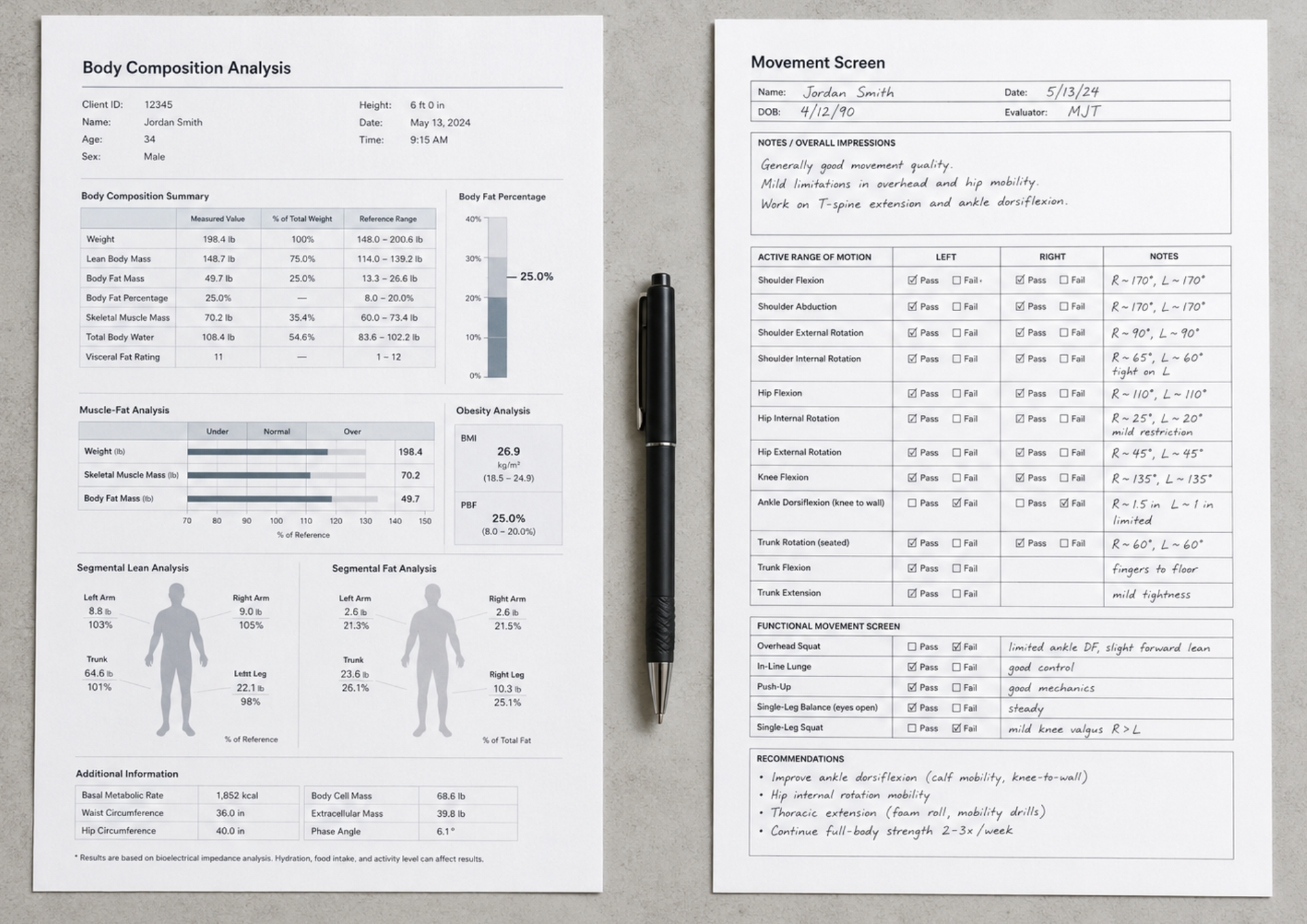
Movement quality and body composition, assessed together before programming begins.
What an Assessment Actually Does
An assessment is not a fitness test. It is not about seeing how many push-ups you can do or what your resting heart rate is. A genuine assessment is a structured process of gathering specific information about a specific body so that the training program built from it is responding to real data, not assumptions.
Done well, an assessment answers questions that matter. Which joints have the range of motion they need and which do not? Where is strength adequate and where is it the limiting factor? Is the ratio of lean muscle to fat tissue appropriate for the goals being pursued, and is there a baseline to measure change against? Is there a history of injury, compensation, or restriction that needs to be addressed before load is added?
The answers to those questions determine everything that follows. The exercise selection. The load prescription. The sequencing of the program. The pacing of progression. None of those decisions should be made without this information, and yet in most training environments, they are made without it every day.
Why Most Programs Skip This Step and What It Costs
Assessment takes time. It requires knowledge to interpret. And in most commercial training environments, neither time nor interpretation is built into the model. You pay for sessions. Sessions mean exercise. So the program starts with exercise, and the assessment — if it happens at all — is reduced to a brief conversation about injury history and goals.
The cost of skipping it shows up predictably. People make progress for a few weeks and then plateau, because the program was calibrated to a generic starting point rather than their actual one. Injuries emerge not from single traumatic events but from accumulated load on a movement pattern that was already compromised before the training began. Progress is measured against the wrong benchmarks because there was no accurate baseline to measure against.
I have written before about the relationship between movement quality and training intensity — specifically, the way that adding intensity to a compromised pattern tends to build the compensation rather than the movement. Assessment is the step that tells you whether a pattern is compromised before you load it. Without it, you find out after.
“Without an assessment, you find out a pattern is compromised after you have already loaded it.”
What the Assessment Covers
The assessment I use with every new client has three components. Each one answers a different question. Together they give a complete picture.
Movement Quality
The first thing I assess is how the body moves, not how much it can lift or how far it can run. I look at how joints rotate, how the spine segments, and how the body manages its own weight through space. Each major joint has a range of motion it should be able to access and control. When a joint cannot get there, or can get there but cannot control it, the body finds a workaround.
Those workarounds are what eventually break things down. The movement screen tells me what the body can tolerate before I add external load to it, and it tells me where corrective work needs to happen first. If a pattern is compromised, I address it before loading it. This connects directly to the principle behind mobility training — the goal is not just range of motion, but the ability to actively control that range under demand.
Strength Baseline
Once movement quality is confirmed, I look at strength. For the clients I work with, most of them professionals in their 40s and 50s. That does not mean chasing a true maximum lift. For someone who has not trained seriously in a few years, a true one-rep max carries real injury risk and tells me less than I need to know.
Instead I use a controlled submaximal effort. You perform as many quality reps as you can at a moderate weight, and I use that data to calculate your actual training capacity across the full load spectrum. What comes out of that process is a set of real training zones for your major lifts, not estimates borrowed from a generic chart, but numbers derived from your body on that day.
Body Composition
Body weight tells you almost nothing about what is happening inside the body. What matters for performance and longevity is the ratio of lean tissue to fat tissue, and specifically whether training is preserving or building muscle as the program progresses.
When DEXA or InBody data is available, I use it. Bone density. Regional lean mass. Skeletal muscle relative to height and frame. Phase angle, which is a marker of cellular health that most people have never heard of but tells a great deal about how the body is functioning at a tissue level. For someone focused on how their body performs and holds up over the next twenty years, these numbers matter more than the number on a scale ever will.
What the Assessment Produces
When I have movement quality data, a strength baseline, and body composition context, I can build a program that is not borrowed from a template. The movement findings tell me what to prioritize, what to protect, and what to hold until the body is ready for it. The strength data gives me exact load prescriptions for any goal on any given day. The body composition data tells me whether the program is working at a structural level over months, not just weeks.
This is the difference between a program that is well-designed in the abstract and a program that is well-designed for you. The former can produce results. The latter is far more likely to, because it is responding to what is actually there rather than what is assumed. And when progress stalls or something does not feel right, the assessment data gives us a reference point. We are not guessing. We know exactly where we started, which means we know exactly how to recalibrate.
If you want to understand more about how strength training fits into this longer view, the article on strength training after 40 covers why building that foundation early is the highest-leverage investment you can make in the decades ahead.
A program well-designed for you is far more likely to produce results than one well-designed in the abstract.
“A program well-designed for you is far more likely to produce results than one well-designed in the abstract.”
Who This Approach Is For
The assessment-first model is not reserved for elite athletes or people with complex injury histories. It is the right starting point for anyone who is serious about training intelligently rather than just training hard.
Most of my clients in San Francisco, Burlingame, Hillsborough, and Atherton are executives and high performers in their 40s and 50s. They are smart, motivated, and accustomed to solving problems with information. What they often discover when we do the assessment is that the information they had about their own body was incomplete, not because they were not paying attention, but because no one had ever actually measured the right things.
The assessment changes that. It gives them a clear picture of where they are starting from, a realistic sense of what the first phase of training needs to address, and a baseline they can measure genuine progress against. It also removes the guesswork from the coaching relationship. We are not experimenting. We are building on a foundation that we both understand.
Every program I build starts with an assessment.
If you are based in San Francisco, Burlingame, Hillsborough, Atherton, or Palo Alto and want a training approach built on what your body actually needs, I work with a small number of clients through concierge in-home training on the Peninsula and private in-studio sessions at Kauno SF in San Francisco. The first step is always understanding where you are starting from.
Get in touch to book a consultation
About Coach Rich Thurman
Coach Rich Thurman is a personal trainer and mobility specialist with over 20 years of experience. He provides concierge in-home personal training in Burlingame, Hillsborough, and Atherton, and in-studio training at Kauno SF in San Francisco. Rich specializes in mobility, functional range conditioning (FRC), strength training for longevity, and sport-specific performance for golfers and other athletes. His approach is assessment-first, education-based, and built around the individual needs of each client.
Related Articles
Why Mobility Training Matters More Than Stretching for Busy Professionals
3 Things to Assess Before Increasing Training Intensity
Strength Training After 40: Why It Is the Most Important Thing You Can Do for Longevity