A More Personal Standard of Training in San Francisco
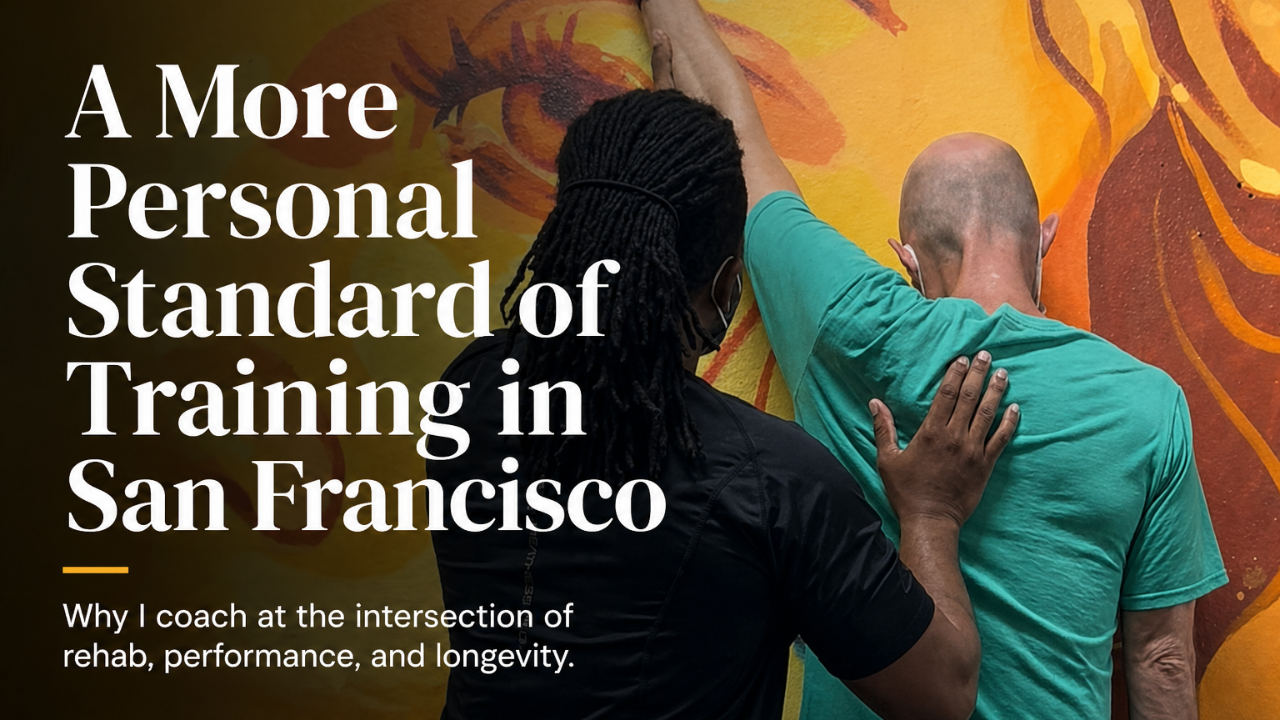
Coach Rich Thurman assisting a client during private personal training in San Francisco
Most people do not need another generic workout plan, another random mobility routine seen on Instagram, or another high intensity CrossFit or Barry’s style fitness trend repackaged as the missing answer.
What many people actually need is a better standard of coaching.
That is the work that I do.
My approach to private personal training in San Francisco and across the Peninsula sits at the intersection of rehab, performance, and longevity because that is where many clients actually reside.
Most people are not looking for entertainment. They are not looking for intensity for the sake of intensity. They are not looking to bounce endlessly between pain, rehab, inconsistent exercise, and starting over.
If you are who I think you are then, you want to:
✅ feel stronger.
✅ move better.
✅ trust your body more.
You want a training process that reflects the demands of real life while still moving forward.
That requires more than workouts.
It requires assessment, structure, precision, and a coaching process that sees the full picture.
Most adults do not fit neatly into one category
One of the problems with the fitness industry is that it tends to divide people into false categories.
You are either injured or healthy.
You are either training for performance or training for general health.
You are either focused on rehab or focused on longevity.
Real life is not that clean.
Many adults live somewhere in between.
You may be struggling with an old back issue that still affects how you train.
You may be active, but stiff, limited, or inconsistent.
You may play golf or tennis and want to perform better without feeling beat up afterwards.
You may want to build muscle and strength but know you cannot ignore movement quality and recovery.
You may be successful professionally and disciplined in many parts of life, but still feel like your body is not responding the way it should.
That is why I do not separate these conversations the way many coaches do.
Because for the right client, rehab history, performance goals, and longevity are not separate issues. They are part of the same story.
Why I coach this way
I have always been less interested in forcing people through exercise and more interested in understanding what is actually happening with your body in particular.
How do you move?
Where are you compensating?
What are you strong enough to do?
What can you access but not control?
What keeps showing up as tension, limitation, or recurring frustration?
How does your work, schedule, travel, or stress shape what training needs to look like?
Those questions matter.
Because when coaching is reduced to motivation, sweat, or generic programming, a lot gets missed.
A person may be working hard and still not progressing well.
They may be stretching constantly and still feel tight.
They may have been cleared after physical therapy and still not feel ready to really train.
They may want longevity, but their current process is quietly taking them in the opposite direction.
This is why my work is assessment-driven and mobility-first.
Not because mobility is trendy, but because movement quality changes what strength can become.
The bridge most people are missing
One of the most common gaps I see is what happens after pain starts to improve but before true confidence and performance return.
That period matters.
A lot of people are no longer in obvious pain, but they are not yet moving well. They have enough function to get by, but not enough clarity to build momentum. They are no longer “in rehab,” but they are also not ready for careless training that ignores how their body is actually working.
That gap is where many people lose time.
They go from physical therapy to random exercise.
They start and stop.
They feel better, then flare up.
They work around limitations instead of resolving what they can.
They stop trusting the process because no one has shown them how to bridge the space between recovery and real performance.
That bridge is a major part of what I do.
I help clients move from pain or limitation toward strength, capability, and long-term resilience with a process that is individualized, measured, and built around more than symptom chasing.
Performance should mean something broader
When I use the word performance, I am not only talking about athletes.
Performance is the ability to do what matters to you with more freedom, more capacity, and fewer physical limitations.
For one person, that may mean returning to strength training without recurring setbacks.
For another, it may mean moving better on the golf course.
For someone else, it may mean handling the demands of work, travel, and life without constantly feeling run down or physically restricted.
For an active adult, it may mean building muscle and preserving physical confidence over time.
Performance is not reserved for elite sport.
It applies to anyone who wants their body to support the life they are building.
Longevity is not passive maintenance
Longevity is another word that gets watered down too easily.
To me, longevity is not just about preserving health markers or avoiding decline in theory.
It is about staying physically capable.
It is about protecting your ability to move well, generate force, recover, adapt, and continue doing meaningful things with confidence. It is about not waking up ten years from now wondering when your body became something you simply manage instead of something you can still use well.
That takes more than exercise for exercise’s sake.
It takes strength.
It takes movement options.
It takes joint function.
It takes intelligent progression.
It takes enough awareness to know when the body needs a different input, not just more of the same one.
Longevity is not built through random effort.
It is built through good structure repeated over time.
Executive Concierge Personal Training in San Francisco and the Peninsula
Why private training matters
The clients I work with best usually do not need more noise.
They do not need crowded rooms, generalized programming, or coaching that treats everyone the same. They need a more thoughtful environment and a more personal process.
Private personal training in San Francisco can offer that when it is done well.
It creates space to assess more clearly.
It allows training to be built around the individual rather than around a class format.
It gives more room for nuance, progression, and adjustment.
It makes it easier to connect mobility, strength, and performance work into one coherent process.
For many professionals and active adults, privacy is not just a luxury detail. It helps remove friction. It creates focus. It allows the work to become more intentional.
That matters.
Who I work with most
My work tends to resonate with people who want more than a hard session.
That often includes:
executives in San Francisco and the Peninsula
active adults who want strength and longevity
golfers and tennis players who want better movement and durability
clients transitioning from rehab back into training
people who value privacy, discretion, and a more individualized standard of coaching
These are often people with high standards.
They are thoughtful.
They are motivated.
They are used to investing in quality.
They are not looking to be sold hype.
They want clarity.
They want coaching that makes sense.
They want a process that reflects both where they are and where they want to go.
Why this matters in San Francisco and the Peninsula
Many of my clients in San Francisco, Burlingame, Hillsborough, across the peninsula to Atherton are dealing with some version of the same reality:
They spend a lot of time sitting.
They work under pressure.
They travel.
They want to stay active and strong.
They know their body needs more than random workouts, but they do not want fitness to become another source of friction.
That is why a private, assessment-driven approach matters here.
For some clients, in-studio personal training in San Francisco makes the most sense. It provides a focused environment for building strength, improving mobility, and creating a more structured path forward.
For others, Executive Concierge Coaching offers a higher-touch option across San Francisco and the Peninsula, with training delivered in a way that better fits schedule, privacy, and lifestyle demands.
In both cases, the principle is the same:
The training should fit the person.
Not the other way around.
What I believe good coaching should do
Good coaching should do more than make someone tired.
It should help them understand their body more clearly.
It should build strength that is useful.
It should improve movement where it matters.
It should respect recovery without lowering the standard.
It should create momentum that feels sustainable, not fragile.
Most of all, it should help a person feel more physically capable over time.
That is the standard I care about.
Not just getting through sessions.
Building a body that supports life, work, performance, and long-term confidence with more consistency and less guesswork.
My final thoughts
I coach at the intersection of rehab, performance, and longevity because I believe that is where better personal training actually lives.
It is where people stop bouncing between disconnected solutions.
It is where movement quality and strength start reinforcing each other.
It is where performance becomes more sustainable.
It is where longevity becomes something you actively build.
For the right client, that is not a luxury.
It is simply a better standard.
If you are looking for private personal training in San Francisco or the Peninsula that is more personal, more thoughtful, and more structured, there are two ways to work with me.
In-Studio Performance is designed for clients who want a focused private training environment in San Francisco.
Executive Concierge Coaching is designed for clients who want a more high-touch, personalized training experience across San Francisco and the Peninsula.
Choose the option that best fits your needs, or apply to start the conversation.